Linear formulas and equations: Linear functions
 Composing a linear formula
Composing a linear formula
|
Procedure |
|
|
With a graph or table of a linear formula, we can compose a formula of the form #y=\blue a \cdot x +\green b# in the following manner. |
|
| Step 1 |
Determine intercept #\green b# by seeing which #y#-value corresponds with #x=0#. |
| Step 2 |
Pick two "nice" or convenient points #A# and #B# with coordinates #\rv{x_A, y_A}# and #\rv{x_B, y_B}#. |
| Step 3 |
Calculate slope #a# with \[\blue a=\frac{y_B-y_A}{x_B-x_A}\] |
| Step 4 |
Enter the found #\blue a# and #\green b# in the formula #y=\blue a \cdot x +\green b#. |
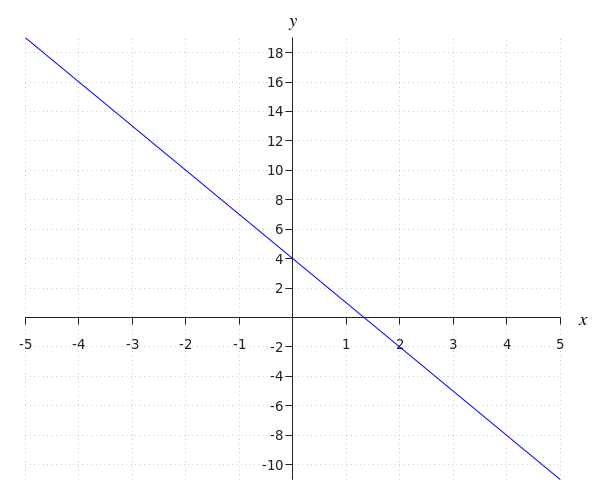
The formula is equal to #y=-3 \cdot x + 4#.
We can calculate this as follows.
Step 1: The intercept #b# is the #y#-value of the intersection point of the line and the #y#-axis. In this case, it is #4#.
Step 2: We choose two grid points, for example #A# with coordinates #\rv{0,4}# and #B# with coordinates #\rv{2,-2}#
Step 3: We now calculate slope #a#. Here, #a=\tfrac{y_B-y_A}{x_B-x_A}=\tfrac{-2-4}{2-0}=\tfrac{-6}{2}=-3#
Step 4: We can now substitute the found values for #a# and #b# in the formula #y=a \cdot x+b#. The formula therefore becomes #y=-3 \cdot x + 4#.
We can calculate this as follows.
Step 1: The intercept #b# is the #y#-value of the intersection point of the line and the #y#-axis. In this case, it is #4#.
Step 2: We choose two grid points, for example #A# with coordinates #\rv{0,4}# and #B# with coordinates #\rv{2,-2}#
Step 3: We now calculate slope #a#. Here, #a=\tfrac{y_B-y_A}{x_B-x_A}=\tfrac{-2-4}{2-0}=\tfrac{-6}{2}=-3#
Step 4: We can now substitute the found values for #a# and #b# in the formula #y=a \cdot x+b#. The formula therefore becomes #y=-3 \cdot x + 4#.
Unlock full access

Teacher access
Request a demo account. We will help you get started with our digital learning environment.